Monday, November 9, 2015

Yale at a Free Speech Crossroads


"I normally, don't do this, and I apologize, but due to the events of the last seventy-two hours, I will have to leave right after my speech. I also apologize for reading my speech, but I haven't slept in four days."

Nicholas Christakis, a professor and Master of Silliman College (one of Yale's twelve undergraduate residential houses) looked like he had the weight of the world on his shoulders, but few of us had any idea what was going on. It would become apparent as the afternoon unfolded as two stories intertwined to tell one: free speech is in critical danger at Yale.


Professor Christakis

We were there for a William F. Buckley Program conference. The title? The Future of Free Speech. Consider this a trigger warning if irony is something you find offensive, because it will bludgeon you over the head, momentarily. The Buckley Program is dedicated to bringing intellectual diversity to campus. Not just the occasional conservative, but speakers like Ayaan Hirsi Ali, an activist for women's rights in the Muslim world. (That was a saga unto itself.) They also have an annual "Disinvitation Dinner," where the keynote is delivered by someone who has been disinvited to speak on a college campus. That would have amused Buckley.

The Buckley Program, mind you, is not supported by Yale. It is privately funded, and its office space is off campus. Yale - the administration, anyway - tolerates it. That's something, anyway.

Christakis began by saying he was a proud liberal and he probably would have disagreed with just about everything Buckley stood for. But, he believed, the left was taking its crusade against free speech too far, that it was a dangerous thing, and that we had to re-learn civil discourse. We didn't realize just how much he was speaking from experience. 

Master Christakis, looking very much in a hurry, finished and left the room, and the conference moved on, albeit with unanswered questions hanging in the air. 

Fast forward about two hours. Another speaker, Greg Lukianoff, clues us in about the events on campus. Master Christakis's wife, Erika, had sent out an email to students about Halloween and campus activists went nuts. This is where the second part of the story starts. Lukianoff says the reaction of students was so strong, "that you'd think someone had burned down a Native American village."

 While Lukianoff was speaking, a campus activist had sneaked in the event and was taping up posters, one after the other. They read:

"Stand with your sisters of sisters of color. Now, here. Always, Everywhere."

As we were trying to understand the relevance of this, a security guard walked over and told the fellow he had to take it outside, that this was a registration-only event. He refused. The guard asked again. Nope, nothing doing. In fact he objected, loudly, and yelled that none of us understood America's history of oppression.

Now the guard had had enough, and he wrestled the kid and his beard though the double doors. Just before they swung closed, he yelled, "And you're talking about burning down Native American villages!"

Things settled down, but I leaned to my friend next to me and said, "This isn't over." I had no idea.

So what had happened to the Christakises? Here are the facts, so you be the judge. The university sent around an email that basically warned students to watch what they wore on Halloween, and that they shouldn't be culturally insensitive. Erika Christakis thought the email went too far, and wrote to the students in Silliman. The is her entire email:


Dear Sillimanders:
Nicholas and I have heard from a number of students who were frustrated by the mass email sent to the student body about appropriate Halloween-wear [more on that below -EV]. I’ve always found Halloween an interesting embodiment of more general adult worries about young people. As some of you may be aware, I teach a class on “The Concept of the Problem Child,” and I was speaking with some of my students yesterday about the ways in which Halloween — traditionally a day of subversion for children and young people — is also an occasion for adults to exert their control.
When I was young, adults were freaked out by the specter of Halloween candy poisoned by lunatics, or spiked with razor blades (despite the absence of a single recorded case of such an event). Now, we’ve grown to fear the sugary candy itself. And this year, we seem afraid that college students are unable to decide how to dress themselves on Halloween.
I don’t wish to trivialize genuine concerns about cultural and personal representation, and other challenges to our lived experience in a plural community. I know that many decent people have proposed guidelines on Halloween costumes from a spirit of avoiding hurt and offense. I laud those goals, in theory, as most of us do. But in practice, I wonder if we should reflect more transparently, as a community, on the consequences of an institutional (which is to say: bureaucratic and administrative) exercise of implied control over college students.
It seems to me that we can have this discussion of costumes on many levels: we can talk about complex issues of identify, free speech, cultural appropriation, and virtue “signalling.” But I wanted to share my thoughts with you from a totally different angle, as an educator concerned with the developmental stages of childhood and young adulthood.
As a former preschool teacher, for example, it is hard for me to give credence to a claim that there is something objectionably “appropriative” about a blonde-haired child’s wanting to be Mulan for a day. Pretend play is the foundation of most cognitive tasks, and it seems to me that we want to be in the business of encouraging the exercise of imagination, not constraining it. I suppose we could agree that there is a difference between fantasizing about an individual character vs. appropriating a culture, wholesale, the latter of which could be seen as (tacky)(offensive)(jejeune)(hurtful), take your pick. But, then, I wonder what is the statute of limitations on dreaming of dressing as Tiana the Frog Princess if you aren’t a black girl from New Orleans? Is it okay if you are eight, but not 18? I don’t know the answer to these questions; they seem unanswerable. Or at the least, they put us on slippery terrain that I, for one, prefer not to cross.
Which is my point. I don’t, actually, trust myself to foist my Halloweenish standards and motives on others. I can’t defend them anymore than you could defend yours. Why do we dress up on Halloween, anyway? Should we start explaining that too? I’ve always been a good mimic and I enjoy accents. I love to travel, too, and have been to every continent but Antarctica. When I lived in Bangladesh, I bought a sari because it was beautiful, even though I looked stupid in it and never wore it once. Am I fetishizing and appropriating others’ cultural experiences? Probably. But I really, really like them too.
Even if we could agree on how to avoid offense — and I’ll note that no one around campus seems overly concerned about the offense taken by religiously conservative folks to skin-revealing costumes — I wonder, and I am not trying to be provocative: Is there no room anymore for a child or young person to be a little bit obnoxious… a little bit inappropriate or provocative or, yes, offensive? American universities were once a safe space not only for maturation but also for a certain regressive, or even transgressive, experience; increasingly, it seems, they have become places of censure and prohibition. And the censure and prohibition come from above, not from yourselves! Are we all okay with this transfer of power? Have we lost faith in young people’s capacity — in your capacity — to exercise self-censure, through social norming, and also in your capacity to ignore or reject things that trouble you? We tend to view this shift from individual to institutional agency as a tradeoff between libertarian vs. liberal values (“liberal” in the American, not European sense of the word).
Nicholas says, if you don’t like a costume someone is wearing, look away, or tell them you are offended. Talk to each other. Free speech and the ability to tolerate offense are the hallmarks of a free and open society.
But — again, speaking as a child development specialist — I think there might be something missing in our discourse about the exercise of free speech (including how we dress ourselves) on campus, and it is this: What does this debate about Halloween costumes say about our view of young adults, of their strength and judgment?
In other words: Whose business is it to control the forms of costumes of young people? It’s not mine, I know that.
Happy Halloween.
Yours sincerely,
Erika

When Lukianoff said, "You'd think they burned down a Native American village," he was referring to the reaction of the campus left to this email. Here is a little taste. Watch, as the left eats its own, in this case the unfortunate Master Christakis:


Best quote: "You are not here to create an intellectual environment, you are here to create a home!!!"

They are now demanding that Master Christakis, and his wife, be fired. If any of this is surprising you, you are out of touch with what's happening on college campuses.

Back to the conference. The noise outside was building. "They're here," I said to my friend. Out of curiosity, I went out to look. There were perhaps twenty students, in high dudgeon, trying to get in to disrupt the conference (did I mention it was about free speech?). I engaged them, which was probably silly. "Why are you here?"

"We are Native Americans and you are talking about burning down Native American villages." (They looked about as Native American as Elizabeth Warren - were they appropriating a culture?) 

"You realize, right, that no one in there is advocating burning down villages, Native American or otherwise? That it was merely an analogy to describe something bad?"

Apparently they did, but that didn't matter. We said the words, and that "trivialized" genocide, and that was the offense. I said, "You do realize that you don't have the right not to be offended, right?"

How wrong I was about that, I later reflected. That may be true, Constitutionally, but I was in a "safe space" where the these delicate orchids are protected from hearing unpleasant things. The right not to be offended now always trumps the right to free speech.

The conference went on for another two hours, and the crowd grew. It was as if they had a button they pushed that sent out an alert - get to these GPS coordinates now, someone said something offensive! Is there an app called Grievance?

They got quite noisy, often making it hard to hear inside, and only an expanding police presence kept them out. At the end, we were escorted out through a phalanx of about 150 students, chanting "Genocide is not a joke." They even found the time to make signs that said things like "You cannot silence us." (There's that irony thing again.)

I filmed our exit:


That wasn't all of them, there were at least one hundred more outside.

Don't imagine any of this is just Yale. It's virtually all of academia, liberal arts schools in particular. They are all at a free speech crossroads. Teachers are now widely afraid of their own liberal students, because the slightest slip - the absence of a trigger warning, for instance - can result in accusations of microaggressions, racism, sexism, cisgenderism, whateverism, and that can result in getting tossed from tenure track. The administrators who make these decisions are afraid of the students, too, because fundamentally, the left has become a mob, and mobs are dangerous. 

These are the bullies of our time.

UPDATE: Two conference attendees claim they were spit on and called racists. I can't claim to have seen this, but I was one of the first people to walk out. The activist who interrupted the conference has been identified as Edward Columbia '18.

UPDATE 2: The Buckley people are circulating a petition in defense of free speech at Yale. It also calls on Yale to reject some of the ridiculous (and dangerous) demands that activists have made on President Salovey. I would urge anyone to sign it.


Wednesday, November 4, 2015

Obama: Great for Liberalism, Bad for Democrats


There have been two remarkable, countervailing, trends since Barack Obama was first elected. The first is that the cause of liberalism has been advanced at a breathtaking rate. Obamacare, higher taxes, open borders, gay marriage...hell, the mere fact we just voted on transgender bathrooms is proof enough (see: Houston). These have been salad days for liberals.

But very bad days for Democrats. With the loss of another governor's mansion yesterday - Kentucky - ponder the shift in the political landscape since Obama was elected:

                                   2008                Now             Difference

Governorships             29                    17                     -12

Senate seats                58                    44                     -14

House seats                257                   188                   -69

State House seats      4082                 3172                 -910


These numbers are breathtaking. Democrats are being eviscerated up and down the ballot. This will have implications that last a generation as the party will have no bench - in particular, no bench from moderate precincts - to elevate to higher races. Who's in line to run at the top of their next ticket, assuming Hillary loses? Have you even heard of Amy Klobuchar? Julian Castro? Consider yourself very informed if you have.

And yet, with a Constitution-ignoring president, a compliant GOP establishment, and left-leaning courts, liberalism marches on. It's no wonder the Republican base is on fire, and is expressing itself with a months long primal scream that takes the form of Donald Trump.

Presumably, these two trends can't go in opposite directions forever, but given the pusillanimous nature of the GOP leadership, it will surely go on for another two years. Should the GOP take the White House, they will have, I think, one last chance to keep conservatives in the fold. When you consider that there are actually more self-identified conservatives in the U.S, than there are registered Republicans, that might seem like a good idea, but the GOP establishment hates conservatives more than they hate Democrats, so don't count on it.

Wednesday, October 28, 2015

The Bumper Sticker Left

Someone - I can't remember who - said that conservatives think, while liberals feel. Rarely do so few words capture so much. The Naked Dollar tried to explain this phenomenon in an earlier post called Conservatives Are from Mars, Liberals from Venus. The reason it's so hard for us to talk to each other is that we have completely different mental processes.

Feeling is way easier, of course, because you get to skip the whole critical analysis bit. You just...feel, and that's sufficient to get your ticket stamped with fellow travelers of the left.

Since an emotion doesn't need to be explained - or even justified - a good liberal finds it's easy to distill their views down to a very few words. So few, that bumper stickers frequently do the trick. Let's take a critical look at some my favorites...


Ah, you know this one. It comes with drivers sporting a mien of smug self-satisfaction, wrapped not merely in the aluminum body of their Prius, but in the knowledge that they are a good, open-minded, people. 

I think that six out of the seven letters are perfectly happy to coexist, there's just this teensie problem with the first one. In fact, when an artist, who goes by the name of "Combo," recently painted this sign in a Muslim suburb of Paris, a mob of open-minded sorts pummeled poor Combo after he refused to take the sign down. He suffered a dislocated shoulder, bruises, and a black eye.

But, you see, the Prius driver isn't telling Muslims to Coexist. No, the message is aimed squarely at the rest of us, who no doubt commit culturally insensitive acts every day. That's why I constantly need to control my impulse to introduce a two-by-four to this bumper sticker and its attendant vehicle. Coexist this.


We saw a lot of these around during the Bush years, didn't we? I once traced them to a particular bookstore in my neighborhood, and about a month after Obama was elected I went in and asked for one. They didn't have them anymore, I was told. "Why not?" I asked. "Isn't dissent still patriotic?" I got a blank stare. Move along.

The fact is, this bumper sticker makes little sense. Dissent, of itself, isn't patriotic. It can be courageous, sometimes noble. But it can also be stupid, idiotic, or even racist. Were the Senators who fought the Civil Rights Act being patriotic? I'm sure they thought so, but I'm also sure that the people who sport this bumper sticker don't. 

I would also point out that in the precincts of the left, particularly college campuses, dissent (of the conservative kind) is now dealt with quite harshly. Just check out the latest atrocities at Wesleyan. No matter: figuring out that particular hypocrisy would involve thinking more than feeling, and that might involve some cognitive dissonance, so why bother.


Oh, come on. Sometimes it is. Like when it stopped, say, Hitler, or ended slavery. 

And then there's this one...


I'm not sure what it means, but it scares the hell out of me.


Saturday, October 17, 2015

Interesting: GOP Betting Markets Beg to Differ With Polls


As Naked Dollar readers know, I am a big fan of prediction markets. These are markets where people bet real money on political outcomes. I like them because they tend to be more accurate than polls. People don't always tell pollsters the truth, but they damn well don't bet money on things they don't think will pay off.

Right now, the prediction markets are taking quite a different view than the polls on the GOP race:

                         RCP Polling Avg.       Nomination Probability

Trump                       23%                                  12%
Carson                      20%                                    6%
Rubio                        10%                                  23%
Bush                           8%                                  15%
Fiorina                        8%                                    6%
Cruz                            8%                                   10%
Huckabee                   3%                                     3%
Paul                            3%                                     4%
Kasich                         3%                                    6%


The market is saying that it's not a buyer of the outsider thesis, at least not yet. Trump and Carson are both trading way below where their poll numbers suggest they should be. Carson, in particular, is getting no love from the market, and this despite the fact he raised an astonishing $20 million last quarter.

On the more establishment side, Rubio, Bush, and Kasich all trade higher than their poll numbers would suggest. Rubio is, in fact, the market favorite right now. Kasich, who is barely registering in the polls, has the same odds of winning as Carson. Wow.

One other fact to ponder: the Iowa Caucus is fourteen weeks away, and no one is at more than 23% to win the nomination. Has there ever been a more wide open race this late?

Stay tuned.

(Technical note: the prediction market data come from Predicit.org. Since the probabilities for all the candidates adds up to much greater than 100% - a market inefficiency - I reduced them all proportionately. I also didn't show a number of candidates that don't have a pulse.)

Friday, October 16, 2015

Multiculturalism and the Death of the Melting Pot


Give me your tired, your poor, your...angry

The melting pot, that uniquely American concept, has met its match.
 
It was a nice run. The melting pot was probably responsible for elevating more people out of poverty than any societal construct before or since, anywhere in the world.

The formula was simple. Immigrants would come to the U.S., find work, and with the dream that the next generation might live a better life, assimilate. Work hard. Join civic organizations. Emphasize English around the home. Figure out the rules to baseball and who Joe DiMaggio was. Root for him, even.


Once, it was important to know who this was

A handful of years later, the next generation was graduating from college, witnessed by teary-eyed parents who perhaps still spoke halting English.

There were bumps. The first generation or two often dealt with some cultural hostility, but it passed. Remember the "shanty" Irish? Nor do most people. Perhaps it's because no one insisted on being called "Irish-American." No one was throwing their cultural heritages overboard, mind you, but they came to America for something better, and becoming "American" was a dream, not a compromise. And it required an extraordinary work ethic and dedication in pursuing new-found opportunities and freedoms unavailable in their home countries. 

Immigrants, and America, were better for it.

And now, in an astonishingly short period of time, the idea of the melting pot has been dismantled by the rising tide of progessivism. It isn't simply that the government's dissipative approach to welfare benefits has undermined the work ethic, it's more than that - it's cultural. In fact, it has a rather pleasant name: multiculturalism.

The Free Dictionary defines multiculturalism thus:

Of or relating to a social or educational theory that encourages interest in many cultures within a society rather than in only a mainstream culture.

So what's wrong with that? A lot, as it turns out, because it emphasizes our differences rather than those things that bring us together. It's supposed to be a celebratory thing, but in reality it breeds Balkanization, resentment, and class envy. This isn't an issue confined to our immigrant community, either.

At a well-known boarding school (that my son attended), they employ a full time "diversity coordinator." As best I can tell, her job is to get everybody mad at one another, and in particular at the prevailing culture. If you happen to fall into her definition of a protected class, you are marinated in righteous anger, often against the culture of the very school that has welcomed you as a student, probably with a scholarship. If you arrive without anger, it will sure graduate with you.

Did I mention the school pays this woman a salary?

There are benefits, of course, for the protected. For example, as a diversity student no one would risk doing anything or saying anything to you that might be turned on you in the form of a racism charge. Few crimes are taken more seriously, and the mere accusation often puts the burden of proof on the accused. 

Some learn to use it to advantage.

Not long ago, at my old high school a black student brandished a letter that he claimed someone had shoved under his door. It contained the "n" word, of course, and phrases like, "You don't belong here in our world." (First hoax clue: who has said anything like that since maybe the 1950s?)

The school, a bastion of Massachusetts liberalism, went into paroxysms of collective soul searching, with town hall meetings and days off for general anguish. The Massachusetts Attorney General got involved, even though it was completely unclear what laws might have been broken. The aggrieved boy gained rarefied victimhood status, at least until it was discovered he wrote the note himself. He had learned well from the grievance industry how to push the right buttons, he just blew the execution. 

Assimilate into traditionally white boarding school culture? You are a racist for even suggesting it. Check your privilege.

Really, it's a shame. Whatever the perceived benefits may be for being a protected class, it winds up being an island of diminished opportunity, just as it is for immigrants who spurn acculturation.

One of multiculturalism's chief tenets is that all cultures are equally deserving of celebration, even though this is demonstrably untrue, and especially so by the very standards trumpeted by the left. Do I need to list the various deprivations of women in most Islamic nations?

The one culture that multiculturalism doesn't celebrate - indeed, has open contempt for - is our American culture. According to all the appointed and self-appointed diversity counselors out there, America is racist, sexist, homophobic, environmentally foolhardy, etc., etc. Thus, like the kids encouraged to resist embracing a boarding school's history and culture, new immigrants are encouraged to hang on to their old cultures and resist becoming "American."

Examples abound. History books in high schools have rewritten American history into a amalgam of conquest and exploitation. Perhaps the worst example is the trend towards teaching immigrant kids in their native Spanish. I can't think of a more efficient way to keep someone poor than to not give them the gift of English. But that would be culturally insensitive, and we can't have that.

Like I said, it was a nice run.

Friday, September 18, 2015

A Lazy Summer


Okay, so you may have noticed I took the summer off. Or maybe not, but many of you gave me grief, so I suppose it's nice someone's paying attention.

There were stories I meant to write, of course, but, well...I mentioned it was summer, right? That, and I'm pretty busy with my new startup, LiquidSky. So here are a few thoughts that accumulated during the dog days.

In June, we had the whole Bruce/Caitlin Jenner thing.


My immediate reaction was if people can just decide what sex they are because it's how they feel, why not race? Why couldn't some white kid, rejected by Harvard for checking the "African American" box, sue Harvard's pants off, saying he identifies black? After all, how you feel now trumps objective fact on a fairly routine basis.

I was about to travel to France with my family, so I figured my piece could wait. 

It couldn't:


While we were in France, the Rachel Dolezal story broke. Damn, that'll teach me to sit on an idea.

It's breathtaking to ponder how much our culture has moved in the last decade or so, and not in the right direction. Miss Dolezal neatly captures many of our current perversities. 


Speaking of France, I hadn't been in a while, and I found it a very perplexing place. Beautiful, for sure. We visited WWI sights in La Somme, WWII sights in Normandy, chateau country in Loire, and finally Paris for a few days. But this is a country so caught up in its own self-identity, that they have achieved a weird, unhealthy, stasis. While the rest of the world moves forward, France remains frozen by choice.

Ever hear of a movie called Bottle Shock? It was made by a classmate of mine, Mark Lhormer. It's a wonderful movie about wine and the "Judgement of Paris," a blind tasting back in the 70s when California wines trounced French wines. The judges were all French, and they were predictably horrified. At that time California wines were thought of as screw-top jugs, maybe from Gallo, perhaps a step removed from Welch's grape juice.

It's a great movie, go rent it. But the point is that the Californians, the crazy cowboys of the industry, were trying new methods. There was no set way of doing things, so they innovated. The French had their methods, and everyone knew French wine was the best, so creativity ground to a halt. To do anything else meant you weren't doing it the "French" way.

So, the Americans blew by them.

I found Bottle Shock to be an apt metaphor for all of France. There is a French way, and you don't mess with it. In all matters cultural, France has immersed itself in a cryogenic chamber of its own making. Honestly, I had very few good meals in two weeks. The art is wonderful, but none of it was created in the last half century. The language itself is tightly regulated by the government, lest "un-French" words dilute its purity. On the business side, well, name one French startup.

All this is also why France has never encouraged the melting pot concept for its immigrants. As a result, Muslims have evolved their own ghettos where Sharia dominates and little French is heard. As Arab immigrants swarm over Europe, it will be interesting to see how France survives as "France."

Which brings me, of course, to Donald Trump.


Look at that hair, would you? It looks like an orange wave, cresting over his face. But whatever. I get asked a lot for my take, so I'll get this out of the way: I don't support him. For one, I don't really know where he stands on many things, and I'm not sure I'd trust him anyway. His views seemed to have "evolved" quite a bit over the years. A little is okay. A lot, not so much.

More importantly, I don't believe he's a man of high character. His business dealings are said to be borderline sleazy, and I've heard many times over the years, from many people, that he cheats at golf. There is absolutely no way someone who cheats at golf - a game where you self-police - should ever be president of the United States. You better believe Mitt Romney would never cheat at golf (but of course he had other issues).

Having said this, Trump is GREAT for the race. Ratings for the debates - debates where many in the field have distinguished themselves - have gone through the roof. Millions of people now know who, say, Carly Fiorina, is because of Trump. I also think he's showing the others how to not be afraid of their own shadows, or the media. I believe that most of the Trump "phenomenon" is explained by his lack of political correctness. People are awfully tired of the ever-growing list of proscribed words and thoughts, and finally, here, someone says, "I couldn't give a crap what you think."

So, Trump has been good for the process, but it's nearing the time to put this flight of fancy to bed.


Sunday, May 10, 2015

The Joyous Republican Free-for-All


A message to GOP voters: don't be in a hurry to pick a horse. There's no hurry, we will learn much more over the coming months.

For conservatives, we have an embarrassment of riches, quite the opposite of four years ago when every option seemed like settling. An informal, totally unscientific poll of friends suggests most are leaning towards Walker. I am inclined to agree, but we need to see how he and others handle the rigors of the campaign trail. We need to see them handle debates, a hostile press corps, and unfolding world affairs, etc.

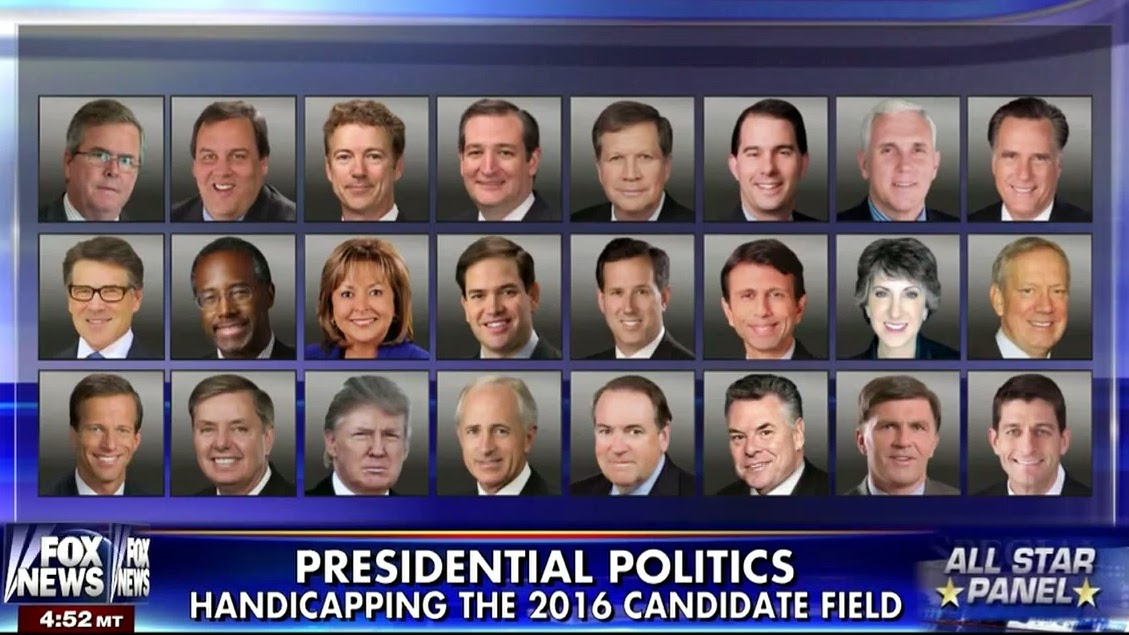
But just for fun, let's give some early ratings to the potential field. I'll give them a grades for desirability and electability, and I've included every conceivable name. This is totally my own opinion, so feel free to disagree. I'll also show the current prediction market odds for those names that have them.


(You may notice that the odds for all the candidates adds up to over 200%, which is obviously impossible. These odds come from a new political gambling site called PredictIt, and it's still highly inefficient. Easy money, if you're interested.)

By reckoning, there are at least four outstanding potential candidates. There are Republicans of every stripe and inclination: establishment, Tea Party, social conservative, and libertarian. There are three Hispanics, three women, an African-American, and one guy with orange hair. How much fun this is going to be compared with Hillary's forced march!

Sit back and enjoy.

Tuesday, April 28, 2015

Periscope - The New New Thing


Every so often, a game changing technology comes along. Go back far enough - five hundred years would do it - and you could live your whole life without a new invention coming along that changed the way the world worked. Go back a century, and there were a handful of game-changers every generation.

Now, it's fair to say there's something that comes along every few months. The latest that I'd like to point in your direction is an app called Periscope. It's pretty simple, really. The idea is that you can use your phone as a video camera and stream what you're seeing live to anyone in the world who wants to watch on their own phone. It's Twitter (who owns Periscope, fyi), except with video. Those watching can live-text messages to which the broadcaster can respond.

Okay, I know what you're thinking. People are going to broadcast all sorts of stupid crap. Kittens, musings on morning coffee, etc. And you'd be right. Most of it is ridiculous. Think of Twitter's early days, when people posted things like, "Hello, world!" I, myself, "periscoped" dinner from a restaurant, just to kick the app's tires. Not interesting, except a high school friend of mine that I've seen once in 30 years jumped on as a viewer. It was a cool moment.

But that's the nature of new mediums, the inane beginnings. People have to figure them out. As Twitter matured, use cases emerged, and Twitter is now inextricably bound to our culture.

So, where will Periscope go? Let me start with a small use case. I was at a baseball game, watching my son, and I turned on Periscope (one click) to broadcast one of my son's at-bats to my wife, who couldn't be there. She watched on her phone while she went about her business (as did six other people, one of whom was from Venezuela). After, with one more click, I saved the video to my camera roll (obligingly, my boy had hit a home run).

But also in recent days I have watched a live feed from the Baltimore riots, a Q&A with Periscope's founder, and a live demo of the Apple Watch.

But so much more is coming, I suspect. How about watching...

  • an ascent of Everest?
  • Q&As with politicians or celebrities?
  • local or school events?
  • the morning break the Pipeline?
  • an arrest gone bad?
  • a concert you couldn't get tickets to?

I'm only scratching the surface here. Periscope doesn't have a search function yet, but when they do, it won't be long until you'll be able to watch anything of significance going on in the world, live. Imagine that.

Thursday, January 22, 2015

Is Hillary Stronger Without a Primary Opponent?


Today, Joe Biden made noises about running. Jerry Brown and Bernie Sanders have also stirred. Jim Webb, and, of course, Elizabeth Warren wait in the wings, pondering, perhaps planning.

Will Hillary have a challenger?

I suspect strongly she will. One of the above will say "it's for the good of the party that there be a choice." If it's Warren, she'd stand a real chance, as I've written before.

Perhaps the interesting question, though, is whether Hillary would be better (or worse) off with a primary opponent. Most pundits I listen to assume she wouldn't be, and I don't doubt Camp Clinton would just as soon dispense with the whole matter. But might she be better off? Normally, my answer would be yes.

A vigorous challenge in the primaries is almost always good for a nominee (assuming, of course, you survive the challenge itself). You get to fine tune your campaign's machinery, hiring and firing to get the optimal staff before the main event, hone your message. You get to practice debating. In Hillary's case, this will be vital, because the Republican nominee will have cut his teeth on nine debates with multiple challengers. And let's face it, Hillary is not a natural. 

Quick, what was the last time Hillary campaigned for office? Answer: 2008. One can assume she's rusty, and she's not a gifted campaigner to begin with, possessing none of her husband's elan or empathy on the trail. In short, the primaries are like spring training, and Hillary will need the innings.

Let's look at the other side, though.

Money is something most people immediately point out. Spend lots of it in the primaries, and you have less for the general. Sure, most of the time, but access to money is not a Clinton weak point. She will have gushers and gushers of it.

Then there's the pesky fact that Hillary's poll numbers always decline the more people are exposed to her. Hiding out for a few months, going to fundraisers in Hollywood while the Republicans exchange blows, seems wise.

But there's something else, something much deadlier, and it's the real reason Hillary desperately wants a coronation. Any of her would-be challengers will come at her from her left flank, and that poses a major problem. 

Now, as an aside, Naked Dollar readers might not think there's much room there, and I would agree. But there's a bit on foreign policy, where she's a sometimes-hawk, and her tight relationship with Wall Street (particularly Goldman Sachs) will be awkward, but really, the situation is that she's a liberal who will be attacked, potentially, by an uber-liberal. Given that Democrat primaries are dominated by the more liberal elements in the party, Hillary will be forced to tack left, and that is not where she wants to go, not at all. For instance, would she have to match Warren's ardor for more Obama-like redistributionist tax schemes? She might, and that would pose a huge problem in the general.

No Democrat ever gets elected president by campaigning as a liberal. Basically, they have to lie about their beliefs. This is most particularly true of Obama, who blatantly campaigned as a middle-of-the-road alternative to Republican extremism, a post-partisan man.

There is a reason this is so, and it's because not very many Americans are liberal. Oh, I know it seems like it, particularly if you live on the coasts, watch mainstream news, or have any exposure to our universities, but it's not the case. Very consistently over time, only 20% Americans self-identify as liberals. (There are far more Democrats than liberals, interestingly.)

Twenty is a long way from fifty, so to win a national election, any Democrat must crush it among moderates. (The opposite is true for Republicans - 40% of America self-identifies as conservative, so Republicans have to run base elections to win, something they seldom seem to understand.)

Hillary would love to spend the primary season staking out all sorts of unchallenged, milk-toasty moderate positions. She would raise the art of vagueness to new heights because that would be the smart thing to do, and how convenient that a platitudinous approach is right in her wheelhouse. But forced by a challenger to apply salve to the base, come the general she won't survive having to defend the things she'll have to say.

I almost always say candidates are stronger having fended off a primary challenge. This time I do not. Camp Clinton is using all its muscle to scare away the pretenders, and their instinct is right.

P.S. The Republican field should be licking it's lips, because this is a win-win for them either way. Rusty Hillary or Liberal Hillary. Game on.

Friday, January 16, 2015

In Defense of Hazing


Have you noticed there has been an explosion of hazing and sexual harassment on America’s campuses? It's everywhere. Not a day goes by when we don't hear of another terrible accusation leveled at some school, somewhere. For every one we hear about, there are likely a hundred that we don't. What's going on?

Much of this stems from the left's usurpation of the language, which I wrote about in De-Coding the Language of the Left. Progressives have been actively redefining certain concepts in order to make them seem like bigger problems than they are, and by so doing, gin up outrage, raise money, and accumulate power. 

President Obama told us recently that one-in-five college women have been the victim of sexual harassment. One in five! Holy cow, our campuses are plagued with rapists. 

It turns out that Obama wasn't lying...if you accept the federal government's new definitions of sexual harassment.

Obama knows, of course, that most of us still think that when he says "harassment," he's referring to "rape." That's what he wants you to think. Outrage, money, power. Repeat. 

Here is an excerpt from the EEOC guidelines on sexual harassment:
Harassment does not have to be of a sexual nature, however, and can include offensive remarks about a person’s sex. For example, it is illegal to harass a woman by making offensive comments about women in general.

Wait, wait, wait - sexual harassment doesn't have to be of a sexual nature? I can just yell, say, "I hate women!" and suddenly I am a sexual predator? Yikes! 

You don't have to take my word for this, you can read the EEOC guidelines here. See for yourself how the bureaucratic minions of the left have been justifying deeper intrusions into American society (Title IX is a popular cudgel).

Of course, the recent Rolling Stone/UVA hoax, as well as Lena's Dunham's fabricated story about being raped by a prominent college Republican, have exposed the Big Lie behind all this, at least to all except the left. It turns out the actual incidence of rape on college campuses is 0.6%, which is actually less than for the rest of society.

At best, sexual harassment is a silly matter, a wolf whistle, at worst something that sends you to prison. You can't say it’s ever a social positive. And therein lies the difference with hazing, for which I'm going to offer a slightly different take. Much of the time is a good thing, one that serves a purpose. That purpose is to bind groups of people together, people who may not have had a connection previously.

Let's take an almost silly example. At my son's school, there is a beautiful grass circle in the middle of campus, and there's a quaint tradition whereby freshmen are not allowed to cross the circle - they have to walk around. If upperclassmen catch them, they chase the offenders off, usually with snowballs or water balloons. They did, that is, until the school administration decided that this constituted hazing. 

As a student, you don't want to mess with a hazing charge, not in today's environment. It can get you expelled in a hurry. "But, ma'am, it was only snowballs" doesn't fly. You are guilty of hazing. You are labeled. The word itself has become politically charged, and it is poison.

The freshman enjoyed the whole ritual, though. Sure, it was a pain to walk around, or to occasionally have snowballs hit you in the face, but it was something they shared, that they endured together. The next year, they would take pleasure in meting out the same punishment to the new kids. Years later, they would reminisce; a small thing, maybe, but a bond nonetheless.

Then there's the typical fraternity initiation, and I speak from experience here. Much of what we were put through I'd be hesitant to put in print (and I'm pretty sure I'd be violating some long-forgotten secret oath), but suffice it to say, while much of the process was harmless, there were other aspects that, if inflicted on anyone at Gitmo, Diane Feinstein would be crying torture and issuing 800-page briefs. The Times would swoon. 

But here's the thing: it was fun. I’ll never forget it. 

It also served a purpose. I didn't know most of the other guys at the start, but by the end I considered them lifelong friends. We had been through this ordeal together, and had to act as a team. I also felt closer to the older guys, because they, too, had endured the same process. So had brothers ten, twenty, or thirty years older. We all had a bond.

Perhaps the harshest example is basic training. Most of us know someone who's been through it, or perhaps you once saw An Officer and a Gentlemen - it's brutal, and it lasts months. But here again, there is a higher purpose, one that saves lives. It's about fitness, teamwork, and esprit de corps. You go in a man, and come out a soldier, as the saying goes. It's not fraternity-like fun, but few say they regret going through it.

So, here's where I have to give the obligatory caveat: there are obviously lines that can't be crossed, mostly ones involving physical harm. But most cases don't cross this line. We need to use some common sense and realize that not all hazing created equally. 

The problem is that hazing has been sucked up into the maelstrom of cultural politics. Think about the institutions most frequently associated with hazing - they are exactly the sort of patriarchal organizations that progressives loathe. Broadening hazing's definition to include harmless traditions is part of a strategy of diminishment. Let's not kid ourselves, it's effective. 

Hazing accusations have been used so successfully that they are now a permanent part of the left's arsenal.

Thank you, sir, you may not have another.